<?xml version="1.0" encoding="UTF-8"?>
<!--Generated by Squarespace Site Server v5.11.81 (http://www.squarespace.com/) on Sat, 18 Feb 2012 17:45:37 GMT--><feed xmlns="http://www.w3.org/2005/Atom" xmlns:dc="http://purl.org/dc/elements/1.1/"><title>Note the Smile</title><subtitle>Blog</subtitle><id>http://notethesmile.org/blog/</id><link rel="alternate" type="application/xhtml+xml" href="http://notethesmile.org/blog/"/><link rel="self" type="application/atom+xml" href="http://notethesmile.org/blog/atom.xml"/><updated>2012-02-16T18:51:08Z</updated><generator uri="http://www.squarespace.com/" version="Squarespace Site Server v5.11.81 (http://www.squarespace.com/)">Squarespace</generator><entry><title>“Where does he get those wonderful toys?”</title><category term="Toys &amp; Play Objects"/><category term="User Experience"/><id>http://notethesmile.org/blog/where-does-he-get-those-wonderful-toys.html</id><link rel="alternate" type="text/html" href="http://notethesmile.org/blog/where-does-he-get-those-wonderful-toys.html"/><author><name>Mike Karlesky</name></author><published>2012-02-13T21:15:00Z</published><updated>2012-02-13T21:15:00Z</updated><content type="html" xml:lang="en-US"><![CDATA[<h3>We interrupt this blog to bring you this special post</h3>
<p>To all five of my regular readers, this post is an experiment in data collection and participation and not the sometimes mildly semi-interesting articles and links I usually put up. In fact, if you could spread this particular post around, that would be seriously awesome.</p>
<p>If you&#8217;re new here, hi there. My name is Mike Karlesky. I&#8217;m a computer science Ph.D. student. More on me <a href="http://notethesmile.org/about">here</a>. My topic of interest is <em>playful technologies</em> (or also what I call <em>playful media</em>). What&#8217;s that you ask? Well. I&#8217;m not talking about video games. Shoot. This is a long story. It&#8217;s probably easiest if you read <a href="http://notethesmile.org/blog/wherein-a-cardboard-box-is-more-like-a-garden-than-a-skyscra.html">this post</a> and maybe look at <a href="http://notethesmile.org/playful-media/">this page</a> or possibly skim this <a href="http://notethesmile.org/featured/">list of articles</a>.</p>
<h3>Please help me out by sharing your experiences with toys</h3>
<p>I&#8217;ve been thinking a great deal about toys and what constitutes the &#8220;toyness&#8221; of toys &#8212; what is it that makes them playful towards embodying those properties in more complex technologies? My thoughts have recently landed on the idea of <a href="http://en.wikipedia.org/wiki/Emergence">emergence</a> (see <a href="http://notethesmile.org/blog/wherein-a-cardboard-box-is-more-like-a-garden-than-a-skyscra.html">post</a> previously referenced), and I hope to explore this notion through your experiences.</p>
<p>This is where I hope you come in. I&#8217;ve disabled the normal comments for this post and replaced them with Disqus because Disqus allows comments to be commented upon and voted up and down. I&#8217;m conducting a completely non-scientific survey towards informing my future research &#8212; all by way of the comments on this post.</p>
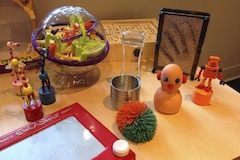
<h3>Here&#8217;s my question: What toy could you play with for hours on end &amp; why?</h3>
<p>Childhood toys or a toy you play with as an adult. Solo play or play with others by way of a given toy. I&#8217;m really interested to know:</p>
<ol>
<li>What toys crystallize the play experience for you in that they are endlessly playable?</li>
<li>Why do you feel that is?</li>
</ol>
<p>Feel free to post links and photos (especially for toys with which a white American Midwesterner such as myself might not be familiar). Please comment on others&#8217; comments and please vote up any comments that echo your feelings on particular toys. If this works well, I hope the most popular comments will be the most informative. Remember, the question is for toys that you once found or still find repeatedly and consistently engaging in play at length. One comment per toy but feel free to comment multiple times.</p>
<p>My conjecture is that many modern digital toys do not embody playfulness as much as consumption (e.g. educational goals or entertainment/amusement). Consequently, one can be &#8220;done&#8221; with these sorts of toys quickly in that they have a limited scope of experience. Hence, because of this, we have the aphorism about cardboard boxes being better toys than that which comes in them. Consider, however, as a counter example that <a href="http://notethesmile.org/blog/the-zen-of-toy-blocks.html">toy blocks seem to be endlessly playable</a>. The definition of a toy is tricky. Many American children love playing with those <a href="http://www.distro-review.com/wp-content/uploads/2011/08/Door-Stops1.jpg">spring-like door stops</a>. Is that a toy? Do your best. I&#8217;m not considering any sort of game, video or otherwise, to be a toy &#8212; though perhaps there are objects within the games that you treated as toys (everybody plays with the <a href="http://en.wikipedia.org/wiki/Mouse_Trap_(board_game)">mousetrap</a> but rarely actually plays the game that contains it). And, yes, there is Minecraft; we can go with that.</p>
<h3>What will happen with the comments collected?</h3>
<p>Great question. I&#8217;m really not entirely sure. For certain, if enough comments come in (fingers crossed), I will synthesize and summarize what we have collectively learned in another post at a later date. And please feel free to do the same. I can&#8217;t promise anything more immediate than this as my actual thesis work will not begin for a while yet and then take quite some time to complete. Nevertheless, I hope this Internet study will inform that research towards building something of immense awesomosity that will contribute to how we play together in the future.</p>
<p>Thank you so much for your help. I hope you find this as enjoyable as I am excited to see what unfolds.</p>
<p>*<span style="font-size: 80%;">The title of this post is, of course, <a href="http://www.imdb.com/title/tt0096895/quotes?qt=qt0371943">a movie quote</a>.</span></p>
<p><span>UPDATE (Feb. 13, 2012): <a href="http://www.wired.com/geekdad/2011/01/the-5-best-toys-of-all-time/all/1">The 5 Best Toys of All Time</a> &mdash; it&#8217;s tongue-in-cheek but also kinda not. {via <a href="https://twitter.com/mvandervoord/status/169186707651039233">@mvandervoord</a>}</span></p>
<p><span>UPDATE (Feb. 16, 2012): <a href="http://www.reddit.com/r/AskReddit/comments/pslnu/a_study_of_a_sort_what_are_your_favorite_toys_and/">Gave same questions to AskReddit</a>.<br /></span></p>
<div id="disqus_thread"></div>
<p><script type="text/javascript">
    var disqus_shortname = 'notethesmile'; // required: replace example with your forum shortname

    /* * * DON'T EDIT BELOW THIS LINE * * */
    (function() {
        var dsq = document.createElement('script'); dsq.type = 'text/javascript'; dsq.async = true;
        dsq.src = 'http://' + disqus_shortname + '.disqus.com/embed.js';
        (document.getElementsByTagName('head')[0] || document.getElementsByTagName('body')[0]).appendChild(dsq);
    })();
</script> <noscript>Please enable JavaScript to view the <a href="http://disqus.com/?ref_noscript">comments powered by Disqus.</a></noscript></p>
]]></content></entry><entry><title>Want an efficient route? Use Google Maps. Want a whimsical route? Use Serendipitor.</title><category term="Play and Adults"/><category term="Playful Design"/><category term="User Experience"/><id>http://notethesmile.org/blog/want-an-efficient-route-use-google-maps-want-a-whimsical-rou.html</id><link rel="alternate" type="text/html" href="http://notethesmile.org/blog/want-an-efficient-route-use-google-maps-want-a-whimsical-rou.html"/><author><name>Mike Karlesky</name></author><published>2012-01-25T18:39:09Z</published><updated>2012-01-25T18:39:09Z</updated><content type="html" xml:lang="en-US"><![CDATA[<p><a href="http://www.buffalonews.com/city/article261320.ece">University at Buffalo professor&#8217;s app adds whimsy to mapped routes</a>:</p>
<blockquote>
<p>Shepard and a few colleagues have developed a mobile application for the  iPhone and iPad that helps its users stumble onto something new or see a  familiar place in a different light.</p>
<p>Their Serendipitor app uses Google Maps to provide a route to a  requested or random destination, but with a set of whimsical  instructions to follow.</p>
<p>Walk behind a dog until it notices you. Find the nearest tree and sit  under it for one minute. Locate a dark alley and walk down it, and if  you can&#8217;t find one just close your eyes.</p>
<p>&#8220;The applications that I  write are trying to get us to stop doing this,&#8221; Shepard said, holding  his face close to his phone, &#8220;and start looking outward again.&#8221;</p>
</blockquote>
]]></content></entry><entry><title>The Young &amp; The Scoreless</title><category term="Play and Adults"/><category term="Playful Design"/><category term="Serious Play"/><category term="Unstructured Free Play"/><id>http://notethesmile.org/blog/the-young-the-scoreless.html</id><link rel="alternate" type="text/html" href="http://notethesmile.org/blog/the-young-the-scoreless.html"/><author><name>Mike Karlesky</name></author><published>2011-12-08T15:09:34Z</published><updated>2011-12-08T15:09:34Z</updated><content type="html" xml:lang="en-US"><![CDATA[<p>Fascinating article from <a href="http://killscreendaily.com">Kill Screen</a>, <a href="http://killscreendaily.com/youngandscoreless/">The Young &amp; The Scoreless</a>:</p>
<blockquote>
<p><span class="dropcap">W</span>e enter this world a wondrous bundle, 100  billion neurons strong and bearing more synapses &mdash; those flashpoints of  memory and sensation &mdash; than the adults we will become&#8230; when we are born we&rsquo;re more aware and learning faster than we ever will  again. Researchers, comparing the brain scans of babies to adults, have  found that the only grown-up experience that even approaches this  awe-inspiring awareness that we feel as infants is when we watch a  really, really good movie or play certain video games. Only then is the  back of our mind lit up like a child&rsquo;s. Only then are we so fully  immersed in a world that isn&rsquo;t really real.</p>
</blockquote>
<p>The article chronicles attempts by game designers wrestling with the challenges of engaging children in real play beyond mere media consumption of video games as well as returning adults to child-like play states. The science involved and the motivations of these designers and technologists are compelling.</p>
<blockquote>
<p>Near the end of his presentation Takahashi gets to the heart of what he  wishes to create &mdash; a return to a child-like, exploratory mind. A return to  pure play.</p>
</blockquote>
<blockquote>
<p>Takahashi&rsquo;s creation may be a valiant attempt at returning adult gamers  to a childlike mind, but this is a nearly impossible thing. Scientists  and academics who study small children, who know better than anyone the  intricate mysteries of the very young, often talk about how much they  would give to experience the world as their subjects do. Some say they&rsquo;d  give back all the awards and accolades they&rsquo;ve ever received to be able  to be three-years-old for just one hour.</p>
</blockquote>
<p>Ultimately the people and projects in the article move on or fall short of their goals. As I read, I found myself cocking my head to one side and thinking there was an obvious problem. Though everyone in the article is speaking about creating true play and crafting playful experiences like none other, it&#8217;s always in the context of video games. Perhaps they are <a href="http://notethesmile.org/blog/wherein-a-cardboard-box-is-more-like-a-garden-than-a-skyscra.html#semantics">mistakenly conflating <em>playful</em> with <em>game</em></a> and are trapped in game-like thinking. What I believe they actually seek is a technology-enhanced creativity and exploration rooted in free play (think playing with blocks) that is not central to games (jumping over mushrooms to save princesses). Of course, I&#8217;m always trying to see the world in terms of playful technology. So there is that.</p>
]]></content></entry><entry><title>Wherein a cardboard box is more like a garden than a skyscraper</title><category term="Playful Design"/><category term="Toys &amp; Play Objects"/><id>http://notethesmile.org/blog/wherein-a-cardboard-box-is-more-like-a-garden-than-a-skyscra.html</id><link rel="alternate" type="text/html" href="http://notethesmile.org/blog/wherein-a-cardboard-box-is-more-like-a-garden-than-a-skyscra.html"/><author><name>Mike Karlesky</name></author><published>2011-12-01T04:20:51Z</published><updated>2011-12-01T04:20:51Z</updated><content type="html" xml:lang="en-US"><![CDATA[<p><span class="full-image-block ssNonEditable"><img src="http://notethesmile.org/storage/post-images/cardboard_boxes.jpg?__SQUARESPACE_CACHEVERSION=1323093757251" alt="" /></span></p>
<p>Let me paraphrase a quote I cannot seem to find (if you know of it, please <a href="http://notethesmile.org/contact">drop me a note</a>). I recall someone once expressing a thought along this line: A new idea does not come so much as a eureka moment but as a series of small discoveries.</p>
<p>What I wrestle with in writing this blog is the process of hanging thoughts on a feeling &#8212; a kind of sense I have that there is an unexplored, significant, uniquely playful direction in which to take technology. At present, I can barely draw the boundaries of this notion and yet I can still feel its edges even as I struggle to put words to it. So recent days have been exciting as I&#8217;ve experienced several small discoveries in just what this idea of playful technology might mean.</p>
<p><a name="semantics">
<h3>The word <em>playful</em> is distinct from <em>game</em> and even from <em>play</em>.</h3>
</a></p>
<p>For a long time I&#8217;ve made the natural association of the word <em>playful</em> with the word <em>play</em>. On its surface, it seems rather obvious. I&#8217;m beginning to think more deeply about this and seem to be moving to a richer understanding of these words. Play encompasses many expressions of the term, encompassing games and non-games alike. What if something that is a type of play is not necessarily playful?</p>
<p>English being both a language wonderfully descriptive but also at times  quite ambiguous, let me get at this distinction with some simple  questions. Can you imagine describing a game as playful? I bet you can.  Can you also imagine describing a very different game without the word <em>playful</em> ever entering your mind? I know I can. Isn&#8217;t that interesting? If a  game is a kind of play then how can one game be thought of as playful  and another as something that&#8217;s not particularly playful? I posit this  is because the semantics of <em>playful</em> and <em>play</em> are not nearly as related as we may think.</p>
<p>When I introduce the phrase &#8220;playful technologies&#8221;, the people to whom I&#8217;m speaking will invariably ask me to explain. For the last few months this is how I&#8217;ve started that conversation&#8230;</p>
<p><strong>Me</strong>: &#8220;You know video games?&#8221;<br /><strong>Them</strong>: &#8220;Yeah?&#8221; (They say with a certain expectant, upward lilt of recognition.)<br /><strong>Me</strong>: &#8220;Okay. Not that.&#8221;</p>
<p>Slowly it&#8217;s begun to sink in that this is a more profound distinction than my pithy, if confounding, way of starting conversations might first seem. In fact, not realizing it, I began to get at this very notion a few months ago when I wrote about <a href="http://notethesmile.org/blog/a-game-minus-all-the-gaminess-equals-an-ungame.html">gaminess and ungames</a>.</p>
<p>&nbsp;</p>
<h3><em>P</em><em>layfulness</em> embodies a sort of organic emergence.</h3>
<p>In general, games are goal oriented. Their structure leads the player down a sometimes lengthy path bounded by a variety of rules to achieve some aim. The whole experience involves many layers of long-form design towards that end. <em>Playful</em> experiences are much different than this. At the core of something playful, there exists an <a href="http://en.wikipedia.org/wiki/Emergence">emergence</a> &#8212; a capacity to spark behaviors or experiences that very well may not have been designed or even intended, a complexity that arises from a multiplicity of simple interactions.</p>
<p>I recently read a transcript of a presentation given by <a href="http://edge.org/memberbio/brian_eno">Brian Eno</a> entitled <a href="http://edge.org/conversation/composers-as-gardeners">Composers as Gardeners</a> that helped me see this. Eno&#8217;s central point is this:</p>
<blockquote>
<p>My topic is the shift from &#8220;architect&#8221; to &#8220;gardener&#8221;, where &#8220;architect&#8221; stands for &#8220;someone who carries a full picture of the work before it is made&#8221;, to &#8220;gardener&#8221; standing for &#8220;someone who plants seeds and waits to see exactly what will come up&#8221;.</p>
</blockquote>
<p>A game is architected. Something that is playful is &#8220;grown&#8221;. Grown in the sense that seeds are planted and at each interaction with a player those seeds instantaneously grow into forms and combinations not necessarily envisioned by the gardener. But just as elaborate architecture can include garden terraces, this distinction between games and playfulness does not preclude a game from including playfulness &#8212; hence the possibility of both games that are playful and games that are not. With its block-based world construction, <a href="http://en.wikipedia.org/wiki/Minecraft">Minecraft</a> is a great example of a video game that is also very playful (and very popular because of it).</p>
<h3>And now onto this business about cardboard boxes.</h3>
<p>How many times have you heard the well worn trope about kids playing more with the box a toy came in than with the toy itself? Isn&#8217;t it interesting that something about this statement rings true however exaggerated it may be.</p>
<p>Blocks (and many other playful objects) have this emergent quality. There&#8217;s just enough there to play with but the experience has not been mapped out to a distinct endpoint as in a game. There exists just enough properties and interactions to allow combinations of simple interactions without end. In the very best kind of playfulness, there&#8217;s hints and suggestions as to how to play but nothing guiding or constricting that freeform expression. The player explores and combines what is already there. In my opinion, this is why so many technology-laden toys fall flat (see <a href="http://notethesmile.org/blog/the-zen-of-toy-blocks.html">The Zen of Toy Blocks</a>). The technology has been incorporated and a few specific interactions designed in such a way as to map out how to arrive at an endpoint. This is not the essence of playfulness, let alone much fun.</p>
<p>Technology added to games has opened an amazing new world. The same has not yet happened in playfulness. I&#8217;m certain I have not expressed my notions here with perfect clarity. And, of course, I&#8217;m still working these ideas out. That said, I believe the way forward is to explore playfulness as emergence through technology &#8212; using technology to imbue objects, spaces, and experiences with the seeds of many simple but emergent interactions. With technology, what has been limited by physical constraints in space or time can be made vastly more intricate. The goal is to not create something more complex. Rather, I&#8217;m proposing that playful technology involves the interweaving of a tremendous number of simple interactions that can be combined in compelling, enthralling, and very new ways only possible through technology.</p>
<p>&nbsp;</p>
<p><span style="font-size: 60%;">(<a href="http://www.flickr.com/photos/fudj/4666786505/in/photostream/">Image</a> by <a href="http://www.flickr.com/photos/fudj/">Paul Lim</a> under <a href="http://creativecommons.org/licenses/by-nd/2.0/">Creative Commons Licence</a>)</span></p>
]]></content></entry><entry><title>Wonder Object: Playful Mechanized Objects by Gary Schott</title><category term="Playful Art"/><category term="Playful Design"/><category term="Toys &amp; Play Objects"/><id>http://notethesmile.org/blog/wonder-object-playful-mechanized-objects-by-gary-schott.html</id><link rel="alternate" type="text/html" href="http://notethesmile.org/blog/wonder-object-playful-mechanized-objects-by-gary-schott.html"/><author><name>Mike Karlesky</name></author><published>2011-11-07T15:01:20Z</published><updated>2011-11-07T15:01:20Z</updated><content type="html" xml:lang="en-US"><![CDATA[<p><span class="full-image-block ssNonEditable"><span><a href="http://www.thisiscolossal.com/2011/11/wonder-object-playful-mechanized-objects-by-gary-schott"><img src="http://notethesmile.org/storage/wonder_object_gary_schott.jpg?__SQUARESPACE_CACHEVERSION=1320678347761" alt="" /></a></span><span class="thumbnail-caption" style="width: 510px;">From Gary&#8217;s Eskimo Kisser series</span></span><a href="http://www.garyschott.com/">Gary Schott</a> is a jeweler, artist, and metalsmith.</p>
<p>Gary creates small kinetic sculptures with a certain whimsy and playfulness. Though certainly not of the high-tech of my interests, Gary&#8217;s work succinctly captures both the essence of playul design and the connection of play to intimacy. Whether it&#8217;s millions of transistors or three gears, playful technology is wondrous.</p>
<p><a href="http://vimeo.com/31262642">View a short documentary</a> on Gary&#8217;s work [Vimeo].</p>
<p>(via <a href="http://vimeo.com/31262642">Colossal</a>)</p>
]]></content></entry><entry><title>Petting Your Password</title><category term="Emotion"/><category term="Play and Adults"/><category term="Toys &amp; Play Objects"/><category term="User Experience"/><category term="Workplace"/><id>http://notethesmile.org/blog/petting-your-password.html</id><link rel="alternate" type="text/html" href="http://notethesmile.org/blog/petting-your-password.html"/><author><name>Mike Karlesky</name></author><published>2011-10-14T19:04:11Z</published><updated>2011-10-14T19:04:11Z</updated><content type="html" xml:lang="en-US"><![CDATA[<p><span class="full-image-block ssNonEditable"><img src="http://notethesmile.org/storage/post-images/SecureTamagotchi.jpg?__SQUARESPACE_CACHEVERSION=1318394774237" alt="" /></span></p>
<p>My grad school funding at present is connected to an <a href="http://www.igert.org/public/about"><span>interdisciplinary</span> program</a> focused on <a href="http://crissp.poly.edu/?page_id=2">security research</a>. That may sound far removed from the direction I&#8217;m supposed to be taking developing the ideas of playful technology and all that. But hold on. Let me throw some knowledge at you.</p>
<p>Security is essential. Or rather, being able to trust our fancypants  computer systems is essential. Security also tends to be seen at odds with usability. Certain design principles can alleviate much of that tension. That said, certain security interactions remain a  pain and inspire frustration at best and outright circumvention at  worst. The intent of my funding is to look at security from a very broad perspective &#8212; including Human Computer Interaction. My advisor and I are exploring how we might use playful interactions to offset certain necessary usability costs in security systems &#8212; <a href="http://www.youtube.com/watch?v=djQdI1t9_Ag">a spoonful of sugar to help the medicine go down</a> (and, yes, that&#8217;s stuck in your head for the rest of the day now).</p>
<p>Some security-related interactions (particularly authentication) are just no fun. Passwords expire at seemingly inopportune moments. They&#8217;re hard to remember, and there&#8217;s so many to remember. Rules for creating them cause you to grumble @&amp;#%! (hey, that&#8217;s a good password right there). A notion we discussed at length is the nature of passwords and security as part of an ecosystem. That is, that security is something you tend like a garden. Katherine even drew the parallel of viewing passwords as having a lifecycle towards asking how a compost heap of old passwords might help fertilize a new crop of digital certificates.</p>
<p>All this lead me to certain ideas (that we&#8217;re not at present pursuing) about creating a kind of tangibility to passwords or security tokens or simply security itself. These things in and of themselves are quite ethereal and very unreal, though the implications of compromised security are very real. There&#8217;s an inherent misalignment in how humans view and interact with security. How might we address this?</p>
<p>It occurs to me that we have passwords that are tangible in some sense already. <a href="http://en.wikipedia.org/wiki/Two-factor_authentication">Two-factor authentication systems</a> often make use of <a href="http://en.wikipedia.org/wiki/Two-factor_authentication#Tokens_with_a_display_.28Disconnected_Tokens.29">pocket-size hardware tokens</a>. It also occurs to me that the form factor and smarts in these tokens is not that far removed from the likes of <a href="http://en.wikipedia.org/wiki/Tamagotchi">Tamagotchi digital pets</a>. So, what if all the techno mumbo jumbo of your digital security profile was crafted into the character of a digital pet? There&#8217;s something hardwired into us that enjoys the act of nurturing. Tamagotchi demonstrate just how compelling that interest to nurture can be &#8212; even if virtual. Actions like walking, feeding, and taking to the veterinarian your digital pet could map to updating your passwords, reviewing privacy settings, responding to policy changes, and maybe even acting socially/communally in the digital equivalent of a dog park. Heck &#8212; old passwords and credentials could even be subject to a pooper scooper.</p>
<p>This is the sort of application of playful technologies I have in mind. And, now, I get to work on such things fulltime. My actual, current research project is quite a bit broader in scope; we&#8217;re yet working to flesh out the concepts. More on that in the months to come.</p>
<p>&nbsp;</p>
<p><span style="font-size: 60%;">(Image: <a href="http://www.flickr.com/photos/purpleslog/265657740/">SecurID</a> by <a href="http://www.flickr.com/photos/purpleslog/">Purple Slog</a> under <a href="http://creativecommons.org/licenses/by/2.0/">Creative Commons license</a>)<br />(Image: <a href="http://www.flickr.com/photos/orqwith/5542556430/">Tamagotchi</a> by <a href="http://www.flickr.com/photos/orqwith/">quimby</a> under <a href="http://creativecommons.org/licenses/by-nc-sa/2.0/">Creative Commons license</a>)</span></p>
]]></content></entry><entry><title>On Doodling: Software with Margins?</title><category term="HCI"/><category term="Serious Play"/><category term="Unstructured Free Play"/><category term="User Experience"/><category term="Workplace"/><id>http://notethesmile.org/blog/on-doodling-software-with-margins.html</id><link rel="alternate" type="text/html" href="http://notethesmile.org/blog/on-doodling-software-with-margins.html"/><author><name>Mike Karlesky</name></author><published>2011-10-04T17:13:29Z</published><updated>2011-10-04T17:13:29Z</updated><content type="html" xml:lang="en-US"><![CDATA[<p><span class="full-image-block ssNonEditable"><span><img src="http://notethesmile.org/storage/post-images/doodling.jpg?__SQUARESPACE_CACHEVERSION=1317769267862" alt="" /></span><span class="thumbnail-caption" style="width: 510px;">Gettin some serious work done here.</span></span></p>
<p>I was sitting in class. Most everyone uses a laptop. During a break in the lecture action, my eyes fell on the keyboard of the laptop a row ahead of me. The owner was mindlessly hitting the arrow keys, bouncing the cursor back and forth. I&#8217;ve done that. And it dawned on me&#8230;</p>
<p>How does one doodle on a computer?</p>
<p>Sure. Drawing tablets or multitouch computers like the iPad certainly allow for free-form sketching. But with these, that sketching is made possible through an application dedicated to sketching and finger or stylus input. I&#8217;m not talking about that.</p>
<p>Paper has margins. Invariably, as one thinks through a problem, daydreams, or momentarily jumps to a tangential thought, that margin gets well used. Who knows what may end up in that margin. Often it&#8217;s fun doodles.</p>
<p>Most non-gaming software is basically some form of productivity software. But here&#8217;s the thing. Productivity with a computer is as much about creativity as it is about merely capturing input and displaying output. Writing. Spreadsheeting. Designing. Arting. Databasing. Searching. Programming. All these require thought and that thought involves creativity. Yet the software that enables all this productivity does little to actively encourage or enhance or receive the requisite creativity.</p>
<p>Doodling is playful. Play is intimately connected to exploration and creativity. I&#8217;ll go so far as to argue that doodling is strongly linked to processing information, thinking, and working out problems on paper.</p>
<p>Because of the highly structured nature of computers and the inherent expense of crafting software, applications tend to be highly structured toward their purpose. As such, there&#8217;s little extra &#8220;room&#8221; outside the bounds of an application for anything other than its specific purpose. Yet, seen more broadly, that extra room might well be essential to the larger aims of the application &#8212; supporting the creativity fueling productivity and workflows. Further, input mechanisms also tend to naturally constrain a user&#8217;s interactions. That is, a keyboard and mouse will naturally motivate a user to type and mouse. These do not motivate doodling. (However, even the iPad with its finger-based input does not spawn applications with space to doodle apart from the task at hand.)</p>
<p>So how do we add &#8220;margins&#8221; to technology so we can doodle? What a great question.</p>
<p>&nbsp;</p>
<p><span style="font-size: 60%;">(Image: <a href="http://www.flickr.com/photos/pivic/1551670033/">Friday-doodle 2/2</a> by <a href="http://www.flickr.com/photos/pivic/">Niklas Pivic</a> under <a href="http://creativecommons.org/licenses/by-nc-sa/2.0/"><span>Creative Commons</span> license</a>)</span></p>
]]></content></entry><entry><title>Misfit of Computer Science</title><category term="Updates &amp; News"/><id>http://notethesmile.org/blog/misfit-of-computer-science.html</id><link rel="alternate" type="text/html" href="http://notethesmile.org/blog/misfit-of-computer-science.html"/><author><name>Mike Karlesky</name></author><published>2011-09-22T04:28:31Z</published><updated>2011-09-22T04:28:31Z</updated><content type="html" xml:lang="en-US"><![CDATA[<p><span class="full-image-block ssNonEditable"><span><img src="http://notethesmile.org/storage/post-images/bussiness_card.jpg?__SQUARESPACE_CACHEVERSION=1316665907447" alt="" /></span></span></p>
<p>My new business cards came in today. They foolishly let me fill out the order form without anyone checking before the cards were printed.</p>
<p>And, yes, I&#8217;m at a game lab even though I&#8217;m trying to work on play apart  from games. I&#8217;ve got &#8212; shall we say &#8212; some leeway. Besides, if I can  get away with these business cards, what else can I get away with,  right?</p>
<p>I got to give my very first business card to <a href="http://waxebb.com/">Drew Davidson</a>, director of Carnegie Mellon&#8217;s <a href="http://www.etc.cmu.edu/site/">Entertainment Technology Center</a>. My advisor brought him in as part of a speaking series. Drew gave a great overview of the ETC and spoke on creativity&#8217;s need for constraints: &#8220;The Best Playground (with an Electric Fence).&#8221; I&#8217;m fairly certain he gets all kinds of cool points from his students.</p>
<p>&nbsp;</p>
<p><em>Bibliography</em></p>
<p>[1] <a href="http://www.imdb.com/title/tt0088568/">Misfits of Science</a>:</p>
<blockquote class="posterous_short_quote">
<p>The adventures of a team of misfit superheroes who fight crime for a scientific think tank. [TV Series, 1985-86]</p>
</blockquote>
]]></content></entry><entry><title>More Toys for Grownups</title><category term="Play and Adults"/><category term="Toys &amp; Play Objects"/><id>http://notethesmile.org/blog/more-toys-for-grownups.html</id><link rel="alternate" type="text/html" href="http://notethesmile.org/blog/more-toys-for-grownups.html"/><author><name>Mike Karlesky</name></author><published>2011-09-15T01:18:11Z</published><updated>2011-09-15T01:18:11Z</updated><content type="html" xml:lang="en-US"><![CDATA[<p><span class="full-image-block ssNonEditable"><span><a href="http://news.yahoo.com/photos/adults-get-life-sized-sandbox-near-las-vegas-strip-1314957923-slideshow/heavy-equipment-instructor-ruben-segura-directs-daniel-la-photo-085003036.html"><img src="http://notethesmile.org/storage/post-images/dig_this.jpg?__SQUARESPACE_CACHEVERSION=1316094032635" alt="" /></a></span><span class="thumbnail-caption" style="width: 510px;">I squish you.</span></span>There&#8217;s a heavy equipment playground near Las Vegas called <a href="http://www.digthis.info/">Dig This&reg;</a> where grownups can use real construction equipment in a giant sandbox!</p>
<p>[<a href="http://news.yahoo.com/adults-life-sized-sandbox-near-las-vegas-strip-091241211.html">article with video</a> &amp; <a href="http://news.yahoo.com/photos/adults-get-life-sized-sandbox-near-las-vegas-strip-1314957923-slideshow/heavy-equipment-instructor-ruben-segura-directs-daniel-la-photo-085003036.html">slide show</a>]</p>
<p>I&#8217;ve written some already about <a href="../../blog/big-people-toys-to-influence-public-policy-behavior.html">big people toys</a> and <a href="http://notethesmile.org/blog/rituals-as-creative-play-for-adults-playful-ritual-objects.html">their significance</a>. Dig This is further demonstration that adults know how to play, want to play, and maybe even need to play.</p>
<p>My goal is to introduce <a href="http://notethesmile.org/playful-media">high-tech into play</a> &#8212; in a larger sense than only gaming. Now that I&#8217;m <a href="../../blog/running-off-to-join-the-circus.html">off at grad school</a>, I&#8217;m just now starting to delve into the topics I hope will get us there.</p>
]]></content></entry><entry><title>Train Station, meet Playground</title><category term="Architecture"/><category term="Economic Development"/><category term="Spaces"/><id>http://notethesmile.org/blog/train-station-meet-playground.html</id><link rel="alternate" type="text/html" href="http://notethesmile.org/blog/train-station-meet-playground.html"/><author><name>Mike Karlesky</name></author><published>2011-09-07T01:25:32Z</published><updated>2011-09-07T01:25:32Z</updated><content type="html" xml:lang="en-US"><![CDATA[<p><span class="full-image-block ssNonEditable"><span><img src="http://notethesmile.org/storage/post-images/Railway-station-slide.jpg?__SQUARESPACE_CACHEVERSION=1315359080120" alt="" /></span><span class="thumbnail-caption" style="width: 510px;">Okay. So not exactly high tech. Who cares. Wheeeeeee!</span></span></p>
<p><a href="http://popupcity.net/2011/07/slide-to-the-train/">Slide To The Train</a>:</p>
<blockquote>
<p>It&#8217;s officially called a &#8220;transfer accelerator&#8221; by Dutch railway maintenance company ProRail, but everyone else would say it&#8217;s a slide. An awesome slide. Installed next to a stairway at the newly renovated railway station Overvecht in the city of Utrecht, the slide offers travellers [sic] the opportunity to quickly reach the railway tracks when they&#8217;re in a hurry. But above all, the slide is a great instrument to make the city more playful.</p>
</blockquote>
<p>[An embedded video in the linked source above takes you down the slide.]</p>
<p>The original post goes on to explain that &#8220;such a playful urban intervention can generate large-scale positive spin-off for a disadvantaged neighborhood like Overvecht.&#8221; I agree. I think playful spaces could be a whole new driver of urban economic development. If designed well (still figuring out what that means), a playful space making good use of technology could be endlessly playful and not merely a novelty.</p>
<p>A previous post on the topic: <a href="http://notethesmile.org/blog/playful-technologies-for-urban-economic-development.html">Playful Technologies for Urban Economic Development</a>.</p>
<p>(via <a href="http://twitter.com/DanielPink/status/111211078679150593">Dan Pink</a>)</p>
]]></content></entry></feed>